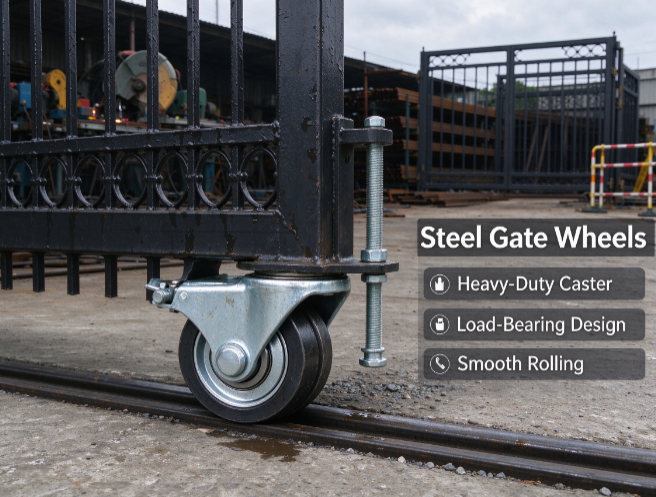
Outdoor sliding gates have to deal with conditions that indoor hardware simply doesn't see. Rain, humidity, dust, mud, temperature changes, road salt, and long hours in the sun can all take a toll on metal components. Steel Gate Wheels have an especially important job because they carry the weight of the gate while rolling over a track that is often exposed to the same outdoor conditions.
For contractors, gate manufacturers, distributors, and maintenance teams, choosing a wheel is about more than diameter and load capacity. Material selection, surface treatment, bearing protection, wheel construction, and the installation environment all affect how the wheel performs over time.
Steel is useful for heavy gates because it can handle substantial loads, but exposed steel needs suitable protection outdoors. Knowing where corrosion starts and what can slow it down gives buyers a much clearer way to compare different wheel options.
Why Outdoor Steel Gate Wheels Are Exposed to Corrosion
Corrosion starts when steel reacts with its surroundings. Water and oxygen are the main factors, while salt, pollutants, dirt, and other contaminants can make the process happen faster.
A gate doesn't need to sit in heavy rain for corrosion to become a problem. Condensation, high humidity, wet ground, and water sitting around the track can keep metal surfaces damp for long periods.
Then there is dirt and mud. Once they collect around the wheel or track, they can hold moisture against the metal. The wheel may look fine after installation, but repeated exposure can gradually damage the surface.
Coastal locations can be harder on steel hardware. Salt from sea air can settle on exposed surfaces, and when moisture is present, it can speed up corrosion.
So, the same wheel can have very different results in different locations. A gate in a relatively dry inland area isn't dealing with the same environment as one installed near the ocean.
How Rust Starts on Steel Gate Wheels
Rust is the visible result of iron corrosion. It often starts where steel is exposed to moisture and oxygen.
A new wheel may leave the factory with a smooth protective finish. Over time, though, handling, installation, contact with the track, scratches, or coating damage can expose the steel underneath.
Once rust begins, the surface can become rough and uneven. That's not ideal for gate hardware. The wheel needs to rotate smoothly and maintain steady contact with the track, and a damaged surface can contribute to increased friction and wear.
This is why corrosion protection shouldn't be judged only by how a wheel looks when it comes out of the box. The finish also needs to hold up during transportation, installation, and normal operation.
Which Parts of a Steel Gate Wheel Need the Most Attention?
A gate wheel is more than just the wheel itself. Several components are exposed to outdoor conditions, and each one can have different problems.
The wheel body comes into direct contact with the track, so it deals with both moisture and mechanical wear. Bearings have a different concern because water and dirt can reach their internal components if protection is inadequate.
Axles, brackets, retaining parts, and fasteners also need attention, especially when they are directly exposed to rain.
| Component |
Typical outdoor concern |
What buyers should check |
| Wheel body |
Surface rust and wear |
Steel grade and surface treatment |
| Bearing |
Moisture and contamination |
Sealing and bearing construction |
| Axle |
Corrosion at exposed areas |
Material and protective finish |
| Bracket |
Rust at edges and joints |
Coating and drainage |
| Fasteners |
Rust around connections |
Compatible corrosion-resistant hardware |
| Track |
Water, dirt, and rust |
Drainage and maintenance requirements |
A wheel can have a good exterior finish and still develop problems if the bearing, axle, or mounting hardware isn't properly protected.
Surface Treatment Makes a Major Difference
Steel components can be protected in several ways, depending on the application.
Painting and powder coating are common options. They create a barrier between the steel and the surrounding environment. When the surface is properly prepared and the coating is applied correctly, this can provide useful outdoor protection.
Galvanizing is another familiar choice. A zinc layer protects the steel underneath and can provide good resistance to outdoor corrosion. Its actual performance depends on factors such as the galvanizing process, coating thickness, environment, and any damage that happens after treatment.
Other options include electroplating and specialized protective finishes.
There isn't one finish that fits every gate.
A wheel used in a dry inland location may have very different requirements from one installed beside the sea or in an area where road salt is regularly used.
For B2B buyers, it's worth asking the supplier exactly what treatment is used, which components receive it, and how the finish is controlled during production.
Why Scratches and Damaged Coatings Matter
Protective coatings don't remain untouched forever.
During shipping or installation, a wheel can hit another metal component. A tool can scratch the surface. A bracket may rub against another part, and abrasive dirt can gradually wear a finish during operation.
Once the underlying steel is exposed, moisture has an easier path to the metal.
Pay particular attention to edges, mounting holes, welds, corners, and other areas where coating coverage can sometimes be more difficult to control.
Manufacturers should have proper surface preparation and coating procedures in place. Buyers can also inspect samples for exposed metal, bubbles, cracks, uneven coating, or obvious scratches before approving a large production order.
A small surface defect may not seem important at the sample stage, but thousands of units with the same issue are a different story.
Bearings Are Critical to Outdoor Gate Wheel Performance
The outside of a gate wheel may be well protected while the bearing still causes trouble.
The bearing allows the wheel to rotate around its axle. If water, dust, or other contamination gets inside, the internal components can become dirty or corroded, increasing friction and affecting movement.
Sealed bearings can help reduce this risk, although the actual protection depends on the bearing construction and the conditions in which the gate operates.
Load is another consideration. A heavy sliding gate puts considerable force on the wheel and bearing, especially if the gate cycles frequently.
Buyers should therefore look at bearing type, load requirements, operating frequency, and environmental exposure together. If the gate is installed somewhere particularly wet or dusty, that should be part of the specification from the start.
Gate Track Conditions Can Affect Wheel Corrosion
It's easy to blame the wheel when something goes wrong, but the track has a lot to do with the working environment.
A track covered with standing water, mud, leaves, or gravel keeps the wheel around moisture for longer. Dirt can also increase rolling resistance and create more abrasion between the wheel and track.
Good drainage helps water move away. Regular cleaning also matters, especially after heavy rain or in areas where leaves and mud build up quickly.
Track alignment is important too. If the gate isn't aligned correctly, the wheel can experience uneven loads or side pressure. That may increase wear on the wheel and bearing.
In other words, corrosion protection is only part of the maintenance picture. A well-finished wheel can't make up for a track that is constantly wet, dirty, or badly aligned.
How Climate Changes Corrosion Risk
Where the gate is installed makes a real difference to corrosion risk.
| Environment |
Main corrosion concern |
Suitable considerations |
| Dry inland area |
Dust and occasional moisture |
Basic protective coating may be sufficient |
| High-humidity area |
Persistent moisture |
Sealing and stronger surface protection |
| Coastal area |
Salt-laden moisture |
Enhanced corrosion-resistant materials or finishes |
| Cold climate |
Snow, ice, and deicing salt |
Corrosion protection plus drainage |
| Industrial area |
Pollutants and chemicals |
Application-specific protective finish |
| Wet agricultural area |
Mud, water, and organic debris |
Sealing, cleaning, and durable coating |
This is one reason manufacturers should ask about the installation location before recommending a wheel.
A standard outdoor specification may work for many projects, but a marine environment or chemically aggressive site can call for different materials or surface treatment.
Does Stainless Steel Always Make More Sense?
Not necessarily.
Stainless steel can provide strong corrosion resistance, depending on the grade and the environment. But it also has different material costs and mechanical characteristics compared with conventional carbon steel.
For heavy sliding gates, buyers may need to balance corrosion resistance with load capacity, wear resistance, manufacturing requirements, and project budget.
A carbon steel wheel with a suitable protective finish can be a practical choice for many outdoor applications. Stainless steel may make more sense for locations with high corrosion exposure or projects where the material is specifically required.
The important thing is to look at the complete operating environment instead of assuming that one material automatically fits every gate.
How Buyers Can Evaluate Corrosion Protection Before Ordering
Looking at a sample is useful, but appearance alone doesn't tell the whole story.
For larger projects, buyers can ask the manufacturer about the steel specification, surface preparation, coating type, coating thickness where relevant, bearing construction, and available corrosion testing.
Salt spray testing is sometimes used to evaluate coatings under controlled laboratory conditions. It can be useful for comparison, but buyers shouldn't treat a certain number of salt spray hours as a direct prediction of how many years a wheel will last outdoors.
Real installations are more complicated. Temperature, humidity, rain, salt, dirt, abrasion, and mechanical wear all change over time.
A more useful evaluation combines available test information with the actual environment where the gate will be installed.
Custom wheels should also be sampled before a large order. Buyers can check dimensions, bearing movement, surface finish, mounting fit, and general manufacturing consistency.
What Manufacturers Should Control During Production
Corrosion performance starts with manufacturing, not after the wheel reaches the customer.
The steel needs to meet the agreed material specification. Machining should keep important dimensions within tolerance, especially around bearing seats and axle interfaces. Welded or fabricated areas also need proper preparation before the finishing process.
Surface preparation is a big deal for painted and coated components. Oil, dust, scale, and other contaminants can prevent a coating from bonding properly.
After finishing, quality checks should look for incomplete coverage, scratches, exposed metal, bubbles, cracks, and other coating defects. Dimensions should also be checked to make sure the finishing process hasn't affected assembly.
Packaging deserves some attention as well. If finished wheels are packed together without enough protection, they can rub against one another during transportation and damage the coating before they even reach the job site.
Maintenance Still Matters After Installation
Even a properly protected wheel needs some basic maintenance.
Gate operators and maintenance teams should inspect the wheel and track from time to time. Mud, leaves, gravel, and other debris should be cleared before they build up.
If rust appears, don't simply paint over it and forget about it. The cause should be checked, and damaged areas should be treated according to the recommendations for the particular coating.
The gate should also be watched for changes in operation. Unusual noise, wobbling, increased resistance, or uneven movement can point to bearing wear, track problems, misalignment, or excessive loading.
A commercial gate that opens and closes many times a day will naturally need closer attention than a gate that only moves occasionally.
Selecting Steel Gate Wheels for Long-Term Outdoor Use
When sourcing Steel Gate Wheels, corrosion resistance should be considered alongside diameter, load rating, bearing design, track compatibility, mounting method, and overall dimensions.
The installation environment matters just as much. A coated carbon steel wheel may be suitable for one outdoor gate, while a coastal installation with regular salt exposure may need a different material or stronger surface protection.
For contractors, distributors, manufacturers, and procurement teams, it helps to define the real operating conditions before comparing products. Tell the supplier where the gate will be installed, how much it weighs, how often it operates, and what kind of weather or contaminants it will face.
Samples, bearing checks, surface-finish inspection, and relevant test information can then be used to narrow down the options.
In the end, outdoor durability doesn't come from the wheel alone. The wheel, bearing, coating, track, drainage, installation, and maintenance all work together. Get those pieces right, and the gate has a much better chance of continuing to roll smoothly after years of exposure.

 English
 русский
 Español