 English
 русский
 Español
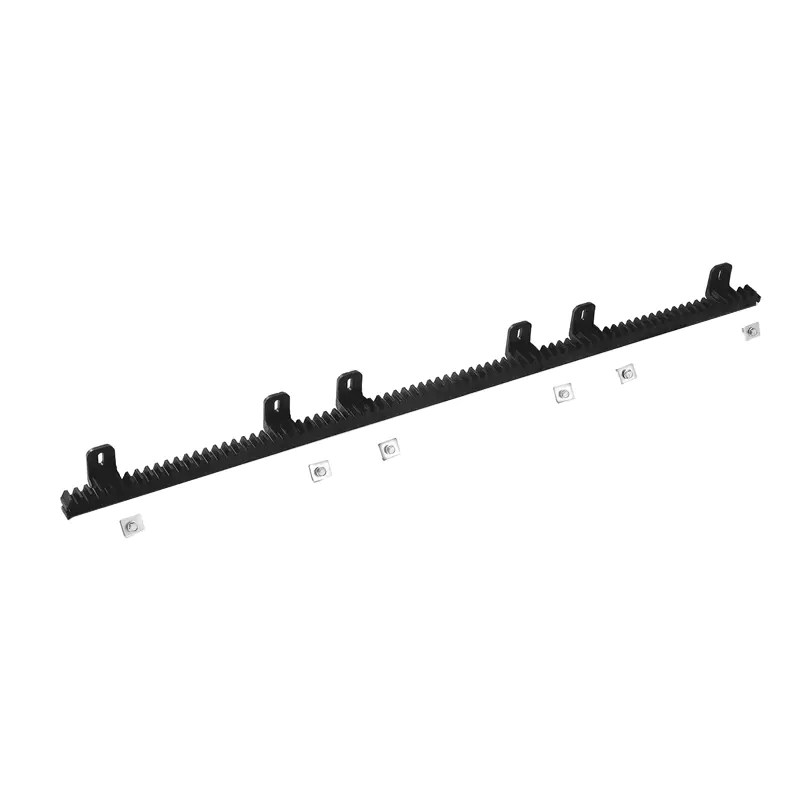
Selecting rack material for an outdoor sliding gate installation is a decision that tends to look straightforward until the system has been running for two or three years. Contractors and procurement teams who have dealt with premature rack degradation — cracking, surface oxidation, dimensional creep under temperature cycling — know that material selection at the specification stage determines whether the system requires ongoing intervention or runs with minimal attention. The difference between a Nylon Rack for Sliding Gate applications and a Stainless Steel Gear Rack is not simply a question of price or noise level. It is a question of how each material behaves under sustained exposure to sunlight, moisture, salt air, temperature variation, and the mechanical load cycles that come with automated gate operation.
What Weather Resistance Actually Means for Gate Rack Systems
The Outdoor Environment Creates Multiple Simultaneous Stresses
A gate rack mounted outdoors is not exposed to one type of environmental stress — it faces several at once. UV radiation from sunlight attacks polymer chains and surface coatings. Rain and humidity introduce moisture into contact surfaces. Temperature swings cause materials to expand and contract, which over many cycles creates fatigue in mechanical joints. Coastal environments add salt particles that accelerate electrochemical corrosion. Industrial environments bring airborne chemicals that degrade both polymer and metal surfaces through mechanisms that are distinct from simple rusting.
A material that handles rain well may still fail under prolonged UV exposure. One that resists UV may corrode in salt air. Evaluating weather resistance requires looking at each of these stressors independently before assessing how a material performs when they operate together — which is the actual outdoor condition.
The stressors relevant to gate rack selection include:
- UV radiation — continuous or seasonal solar exposure that degrades surface finish and polymer structure over time
- Rain and standing moisture — direct water contact, capillary action at joints, and humidity cycling that promotes corrosion or material swelling
- Temperature variation — daily and seasonal cycling that causes expansion, contraction, and accumulated dimensional change
- Salt and chemical exposure — coastal salt spray, road de-icing chemicals, and industrial pollutants that attack metal surfaces and some polymer formulations
- Mechanical wear combined with environmental exposure — the Nylon Rack and Pinion gear interface experiences both contact stress and environmental effects simultaneously, and those factors interact in ways that affect wear rate
Nylon Rack for Sliding Gate: How It Responds to Outdoor Conditions
UV Exposure Is the Variable That Sharply Divides Nylon Products
Nylon — more precisely, polyamide — is not a single material. The mechanical and environmental performance of nylon rack products varies considerably based on the polymer grade, the presence of UV stabilizers, fiber reinforcement, and the additives incorporated during production. This variation is worth understanding because it explains why nylon racks perform very differently across different product tiers.
Standard nylon without UV stabilization absorbs UV radiation and experiences photo-oxidation. The polymer chains break down, surface chalking appears, and the material becomes brittle over time. In regions with high solar intensity — southern coastal areas, desert climates, or high-altitude locations where UV levels are elevated — untreated nylon can show visible degradation within a relatively short outdoor service period.
UV-stabilized nylon, by contrast, incorporates additives that absorb or scatter UV energy before it reaches the polymer backbone. Products manufactured for outdoor gate applications should specify UV stabilization as a standard feature, not an option. Glass-fiber reinforced nylon compounds offer improved dimensional stability under temperature cycling, which is relevant in climates with significant seasonal temperature variation.
The moisture behavior of nylon is another characteristic worth knowing. Nylon absorbs some moisture from its environment, and this absorption causes slight dimensional change — a phenomenon called hygroscopic swelling. For a Nylon Rack and Pinion gear system, this means the rack dimensions will vary slightly with ambient humidity. In gate applications, this variation falls within acceptable tolerances and does not affect system function. However, in systems with very tight engagement tolerances, or in environments with humidity swings, it becomes a factor in long-term precision.
Nylon's corrosion immunity is its clearest advantage over steel in moisture-rich environments. The material does not rust, does not require protective coating on contact surfaces, and does not suffer the electrochemical degradation that affects steel in wet or salt-laden conditions. In high-humidity tropical climates or locations where maintaining coating integrity on a metal rack would require frequent inspection, this characteristic simplifies the maintenance picture considerably.
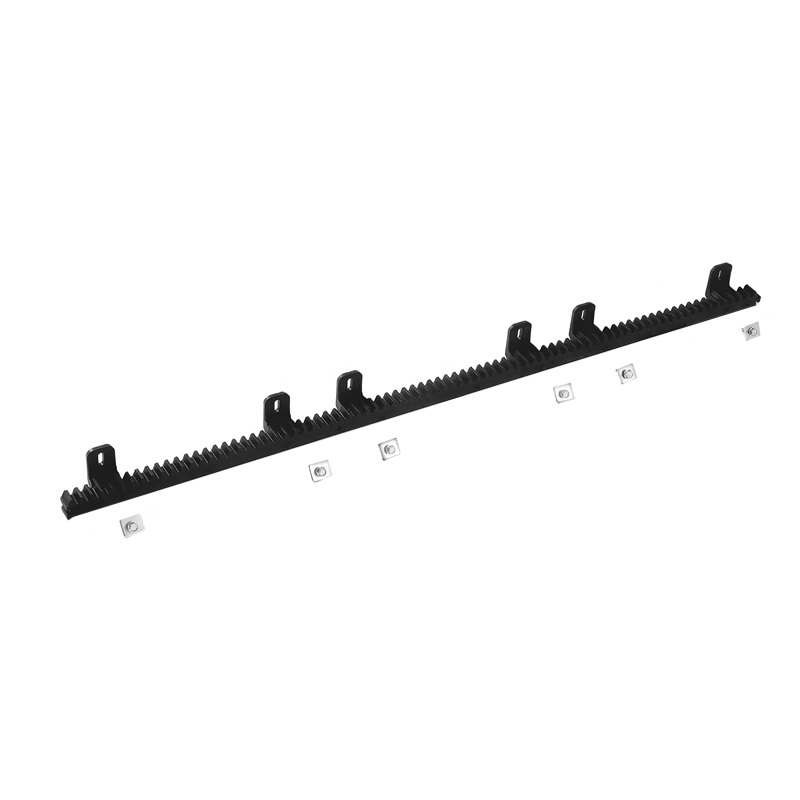
Advantages of nylon rack in outdoor use:
- No rusting or electrochemical corrosion regardless of moisture level
- Naturally quiet in operation — no metal-on-metal contact noise at the drive interface
- Lighter weight simplifies installation, particularly for longer rack runs
- No lubrication requirement at the rack surface in many applications, which eliminates a maintenance task and removes the risk of lubricant attracting debris
- Effective in coastal and humid environments where coating maintenance on steel would be ongoing
Limitations to account for:
- UV performance depends directly on stabilizer grade — not all nylon racks are equivalent
- Long-term creep under sustained mechanical load is more pronounced than in steel
- Thermal expansion coefficient is higher than steel, which affects dimensional behavior across temperature ranges
- Maximum load capacity is lower than equivalent steel rack, which limits use in very heavy gate applications
Stainless Steel Gear Rack: Environmental Durability Under Sustained Exposure
Stainless Steel Performs Consistently Where UV and Temperature Create Problems for Polymers
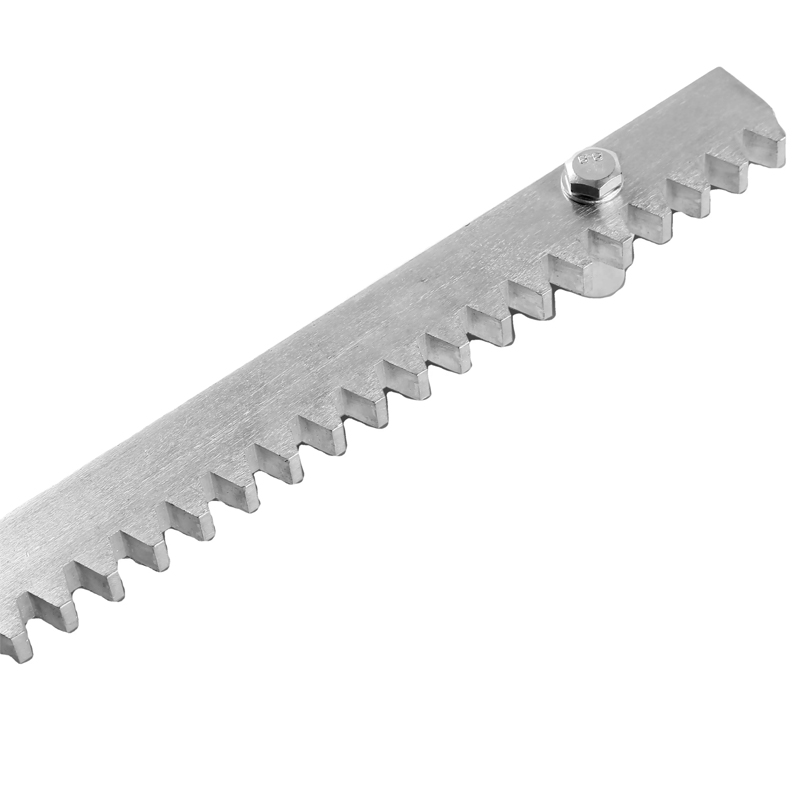
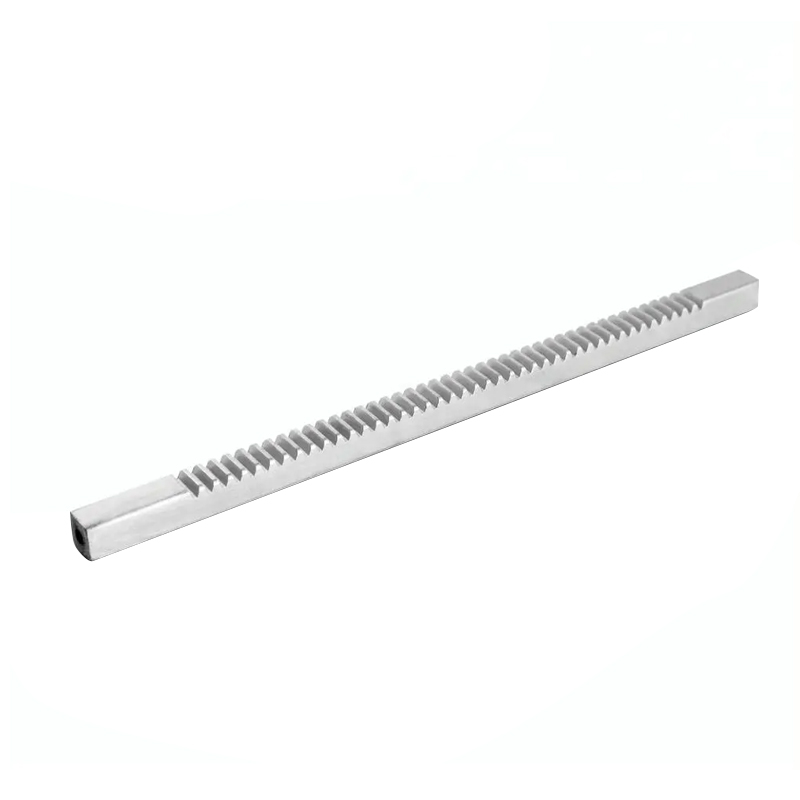
Stainless Steel Gear Rack products bring a different set of properties to outdoor gate applications. The material's fundamental advantage is structural and dimensional stability — it does not change meaningfully in response to UV exposure, it maintains its mechanical properties across a wide temperature range, and it does not creep under sustained load the way polymer materials can.
UV radiation has essentially no effect on stainless steel. The material does not absorb solar energy in ways that degrade its mechanical structure. This makes it particularly well-suited to environments with intense and prolonged sunlight, where even UV-stabilized nylon compounds face some degree of long-term surface change.
Temperature stability is another area where steel behaves differently from nylon. The thermal expansion coefficient of steel is substantially lower than that of engineering polymers. In climates with wide temperature swings — central continental climates where summer and winter temperatures differ greatly — a steel rack maintains dimensional consistency that directly supports reliable drive engagement throughout the year. This matters in automated gate systems where the precision of the rack-and-pinion interface affects both mechanical performance and motor load.
Corrosion resistance in stainless steel depends on grade. The passive oxide layer that gives stainless steel its corrosion resistance is stable in outdoor environments, but salt-laden coastal air or aggressive industrial atmospheres can compromise it over time if the steel grade is not matched to the environment. For coastal applications, higher-alloy grades offer better protection against pitting and surface oxidation, though they carry a higher unit cost than standard grades.
The weight and rigidity of steel rack create installation considerations that are different from nylon. Longer steel rack sections require more support, and the rack-to-motor interface must handle the higher inertia of a steel system. These are engineering factors, not objections to the material — they simply need to be accounted for in system design.
Advantages of stainless steel rack in outdoor use:
- UV exposure causes no mechanical degradation — stable performance in high-sunlight environments
- Low thermal expansion maintains dimensional consistency across temperature ranges
- High load capacity supports heavy or oversized gate panels
- Long structural service life in outdoor environments with appropriate grade selection
- No hygroscopic dimension change — stable geometry in varying humidity conditions
Limitations to account for:
- Corrosion resistance depends on grade — coastal and chemically aggressive environments require specific alloy selection
- Heavier and more difficult to handle in installation, particularly for long rack runs
- Higher noise at the drive interface compared to Nylon Rack and Pinion systems
- Requires surface lubrication for reliable long-term operation, which introduces a maintenance task
How Different Climate Types Affect the Selection Decision
Climate type is one of the clearest ways to organize the material selection decision. The combination of stressors that characterizes a given location creates a performance profile that either favors nylon or stainless steel — or, in some cases, suggests a hybrid approach.
Tropical and high-humidity climates
These environments bring sustained moisture, high temperatures, and in coastal versions, salt air. Nylon's corrosion immunity is a real advantage here, and UV-stabilized grades perform adequately in the diffuse solar conditions typical of cloudy humid regions. For coastal locations within this category, the salt resistance of nylon becomes more significant — maintaining coating integrity on a steel rack in salt air requires consistent attention, while nylon requires no such management.
Arid and high-UV climates
Desert environments combine intense solar radiation with low humidity and wide daily temperature swings. UV degradation is the primary risk for nylon in these conditions, and only well-stabilized grades should be considered. Stainless steel performs well here — UV has no effect, and the low humidity reduces the corrosion risk. The large daily temperature variation is better handled by steel's lower thermal expansion coefficient.
Cold and freezing climates
In cold climates, ice formation at the rack and pinion interface is a practical concern. Nylon has better impact resistance at low temperatures than some other polymers, and its corrosion immunity removes one failure mode. Steel remains dimensionally stable at low temperatures and can handle the mechanical loads of gates that may move snow or ice accumulation. The primary concern in these environments is lubricant behavior at low temperatures for steel rack systems.
Coastal and salt-spray environments
Salt air is probably the environment where material selection carries the consequence. Nylon performs well here — it is genuinely immune to the electrochemical processes that affect steel. Stainless steel can also perform well in coastal environments, but grade selection is critical. In environments with persistent salt spray rather than occasional coastal exposure, Nylon Rack for Sliding Gate applications frequently emerges as the lower-maintenance choice for standard gate weight classes.
Industrial and chemically contaminated environments
Where airborne chemical exposure is a factor — near processing facilities, agricultural operations using fertilizers, or infrastructure near water treatment — material compatibility with the specific chemical environment should be confirmed before specifying either material. Some industrial chemicals attack nylon specifically; others attack steel coatings while leaving nylon unaffected.
A Side-by-Side Material Comparison for Outdoor Gate Applications
| Performance Factor | Nylon Rack | Stainless Steel Gear Rack |
|---|---|---|
| UV resistance | Grade-dependent; UV stabilization required | Not affected by UV exposure |
| Corrosion resistance | Inherently corrosion-proof | Grade-dependent; coastal grades required for salt environments |
| Temperature stability | Higher thermal expansion; moderate dimensional change | Low expansion; stable across temperature ranges |
| Load capacity | Suitable for standard residential and light commercial | Handles heavy gates and high-cycle industrial applications |
| Moisture behavior | Slight dimensional change from humidity absorption | No hygroscopic effect |
| Noise level | Quiet operation at drive interface | Higher noise; lubrication helps but does not eliminate |
| Maintenance requirements | Low; no lubrication at rack surface | Requires lubrication; coating inspection in corrosive environments |
| Installation weight | Lighter; easier handling for long rack runs | Heavier; requires more support points |
Long-Term Maintenance Costs: A Factor Often Overlooked at Selection Stage
How Does Material Choice Affect Maintenance Frequency and Cost Over the System's Life?
Initial installation cost is usually the number that receives the attention in procurement decisions, but maintenance cost over the system's operating life often exceeds the initial material cost difference. Gate rack systems installed in outdoor environments are not set-and-forget components — they require periodic inspection, and depending on the material and environment, active maintenance.
For nylon rack systems in appropriate environments:
- No lubrication at the rack surface in many drive configurations
- No coating inspection or touch-up required
- Inspection focus shifts to monitoring for wear at the tooth profile — a visual check rather than a material integrity assessment
- UV stabilizer effectiveness should be confirmed at installation; high-grade nylon products retain performance for extended outdoor service periods
For stainless steel rack systems:
- Lubrication at the rack and pinion gear interface is a recurring maintenance task — frequency depends on the drive cycle rate and environmental exposure
- In corrosive environments, surface condition should be inspected at regular intervals to catch pitting or surface oxidation before it progresses to structural corrosion
- Re-application of surface treatments may be required over the system life in aggressive environments
- The structural integrity of steel rack is not a maintenance concern under normal conditions — the mechanical properties do not degrade in the way that polymer aging can affect nylon
Gate Rack Nylon in Heavy-Duty and Industrial Applications
Where Are the Load and Cycle Limits for Nylon Rack Systems?
Nylon rack is widely used in residential and light commercial gate applications, and performs reliably in those contexts when the material grade is appropriate for the environment. Moving into heavier gate panels, higher cycle frequencies, or industrial security gate applications changes the load picture.
Under sustained high load, nylon experiences slow plastic deformation — creep — at the tooth root over time. In residential gates operating at moderate cycle frequencies, this is not a practical concern across normal service periods. In industrial applications with heavy panels cycling many times per day, the cumulative deformation affects tooth geometry and eventually drive engagement precision.
For these applications:
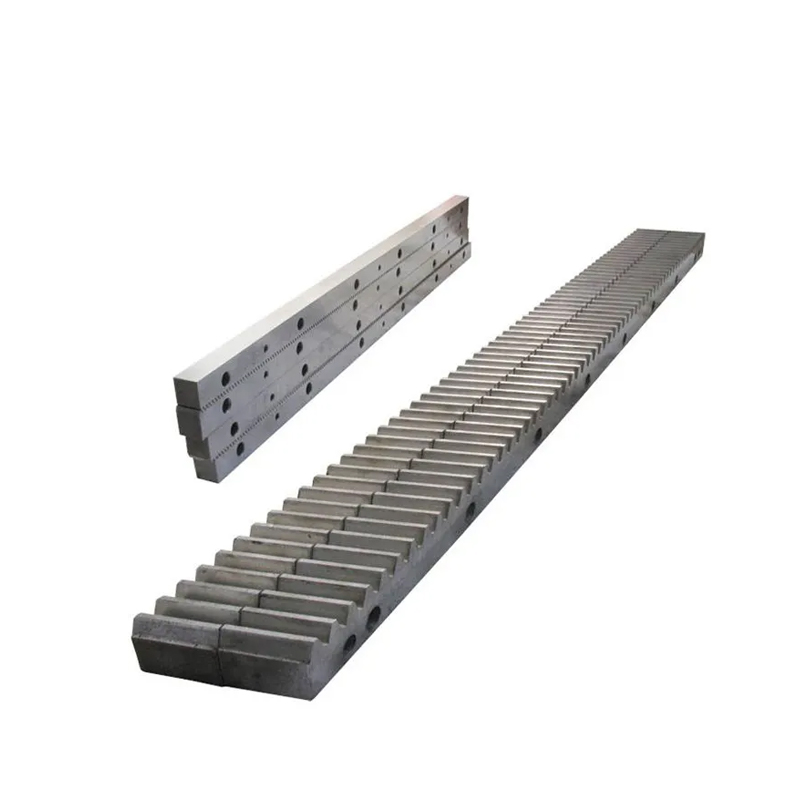
- Steel rack is generally the specification choice where gate weight or cycle frequency pushes into industrial territory
- Hybrid systems — using steel rack for the primary drive engagement zone and nylon rack for sections that see lower load — are used in some applications to balance cost, noise, and durability
- Gate rack nylon products designed specifically for heavier applications incorporate glass fiber reinforcement and are rated for higher loads than standard grades, which extends the weight range where nylon remains viable
The Nylon Rack and Pinion gear combination is common in residential automated gates globally. It handles the load and cycle profile of that application well, produces quieter operation than steel, and reduces maintenance requirements in the environments where residential gates are installed. The engineering limits become relevant when gate specifications move beyond the residential category.
Making the Material Decision: A Structured Approach
What Information Should Guide the Final Selection?
A structured approach to material selection avoids the common error — choosing based on price or habit rather than application requirements. The following steps provide a framework:
- Define the environmental exposure profile. Identify the primary stressors: UV intensity, coastal salt exposure, temperature range, humidity level, and any specific chemical exposure relevant to the installation location.
- Establish the mechanical requirements. Determine the gate panel weight, drive cycle frequency, and whether the application falls within the residential, commercial, or industrial load range.
- Assess maintenance access and budget. Some installation locations make regular maintenance difficult; others have maintenance programs that handle lubrication and inspection as standard practice.
- Match material to environment and load. Use the environmental profile and load requirements to identify which material category — nylon, stainless steel, or a hybrid approach — is appropriate.
- Verify product grade within the material category. Not all nylon racks are UV-stabilized, and not all stainless steel grades offer equivalent corrosion resistance. The specific product specification matters.
- Consider total life-cycle cost. Include installation cost, expected maintenance intervals and costs, and estimated replacement frequency over the system's intended service life.
Selecting the Right Rack for Long-Term Outdoor Performance
Material selection for outdoor gate rack systems is a decision with long-term consequences that extend well beyond the initial installation cost. A Nylon Rack for Sliding Gate use in a high-humidity, moderate-load residential context may outperform a steel rack from a total cost perspective over a decade of operation. In a coastal industrial application with heavy panels cycling frequently in salt air, the calculation shifts. Neither material is universally appropriate — the right answer depends on the specific combination of environment, load, cycle rate, and maintenance infrastructure.
For contractors specifying gate systems, procurement teams sourcing rack components, and project owners evaluating long-term system reliability, the material comparison here provides a starting point. The next step is matching those general principles to the specific conditions of the installation. Zhejiang Luxin Door Operation Equipment Co., Ltd. manufactures gate rack and drive system components for sliding gate applications across residential, commercial, and industrial specifications, with product options in both nylon and steel configurations suited to different environmental and load requirements. Reaching out to discuss the specific conditions of your installation is a practical way to confirm that the material and product grade selected will hold up over the system's intended service life.